Preparing "It's Hard to Speak My Heart": A Framework for the Singing Actor
On verb actioning, psychological gesture, and eye focus in a single audition cut
Process · Audition Prep · Musical Theatre · April 2026
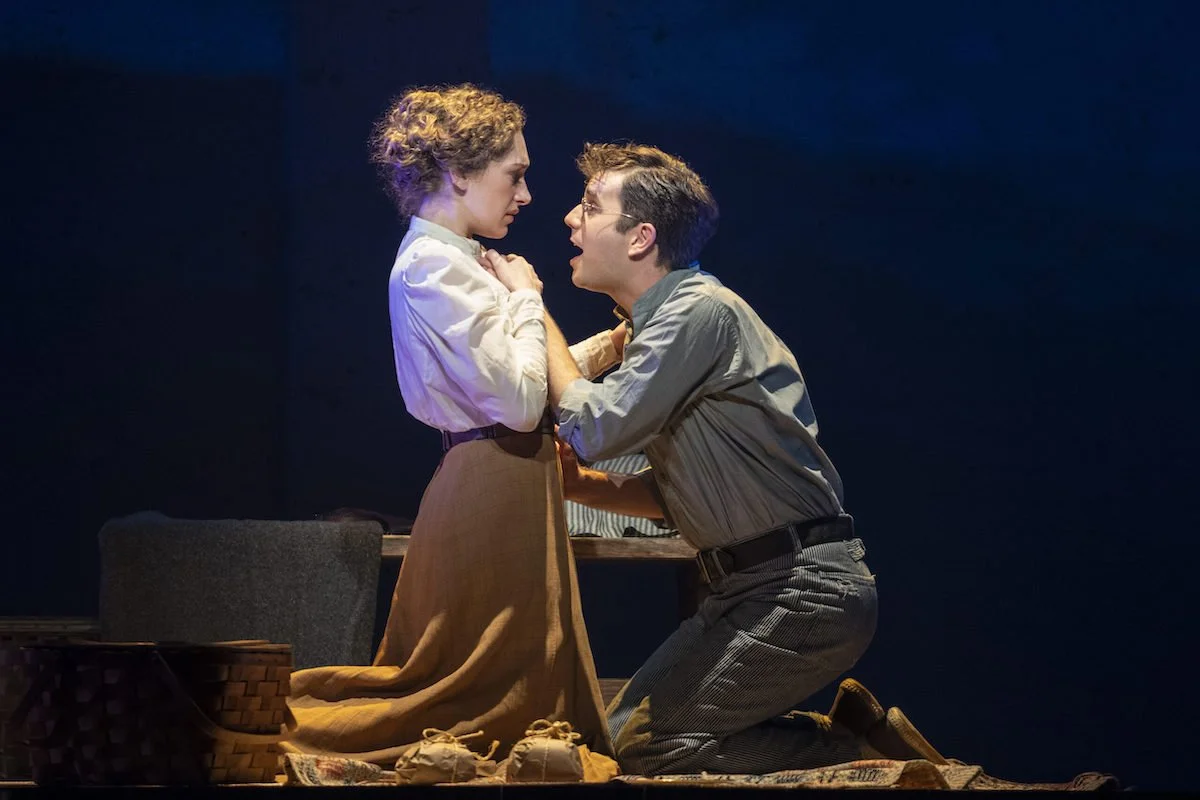
Micaela Diamond & Ben Platt in Parade
I have been carrying "It's Hard to Speak My Heart" in my audition book for several years. It fits my voice: a mid-to-high baritone, classical foundation and continuing the process of developing a head-first pop-adjacent grain, comfortable in the JRB harmonic language, and mostly able to sustain the emotional weight of the lyric without straining. That seemed like enough for a long time. It was a song I knew I could sing well, and in my earlier performing life, singing something well was often where the preparation ended. Really diving into a character and inhabiting multiple techniques for engaging a character’s emotions, mind, and body is something I developed in the director’s chair when I wasn’t performing as much anymore.
What I'm describing is the application of a director's brain to a performer's body. For most of my career in the performing arts I was on the other side of the table as a director and producer. Coming back to performance after years away, I've found that training doesn't disappear. It just changes rooms. What I now bring to audition prep is a process I built from that cross-disciplinary background, and "It's Hard to Speak My Heart" is where I've given it a recent workout.
The History in the Song
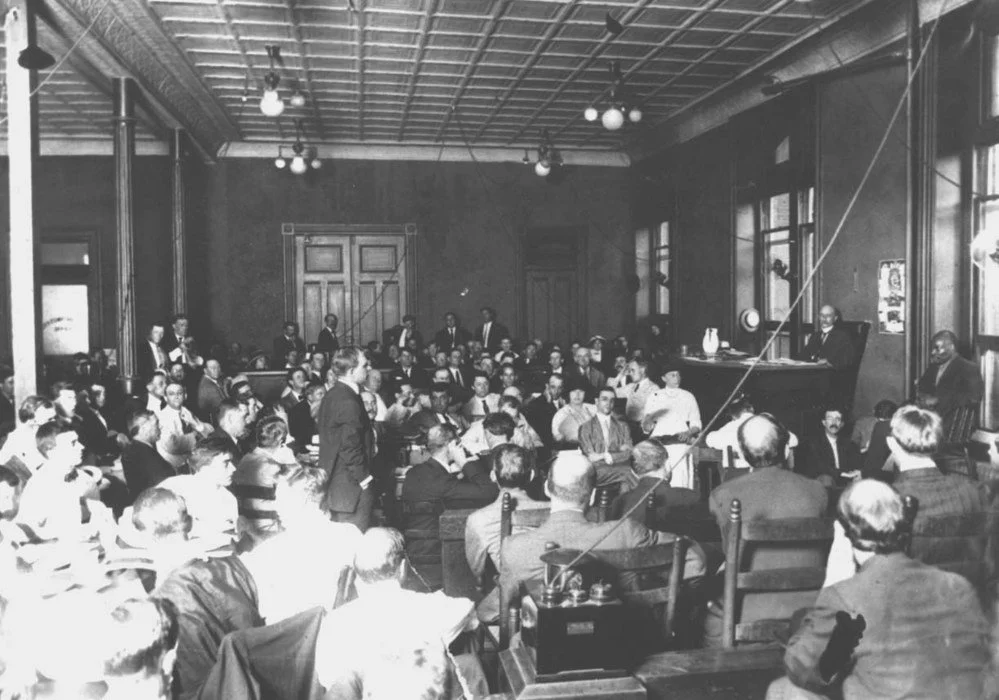
Leo Frank Trial, Fulton County Courtroom, Atlanta 1913
Leo Frank was a 29-year-old Jewish factory superintendent in Atlanta when a 13-year-old worker named Mary Phagan was found murdered in the factory basement in April 1913. The evidence against him was circumstantial at best. The prosecution's case rested almost entirely on Jim Conley, a factory janitor who gave four contradictory affidavits while held in solitary confinement for six weeks before trial. Modern historical consensus holds that Conley was the actual killer. Frank was convicted anyway, in a courthouse surrounded by crowds chanting for his death, with the jury aware that acquittal might not let them leave the building alive.
Governor John Slaton, after reviewing the case, commuted Frank's death sentence in June 1915. A mob calling itself the Knights of Mary Phagan kidnapped him from prison two months later and lynched him in Mary Phagan's hometown of Marietta. Stores sold postcards of the body. The prosecutor became governor. Several members of the lynching party were charter members of the newly reborn Ku Klux Klan, which burned a cross on Stone Mountain that November.
The Anti-Defamation League, founded the same year as Frank's trial, took his case as its first cause and eventually helped secure his posthumous pardon in 1986. As of 2025, Fulton County's Conviction Integrity Unit still has the case file under active review. The case remains technically unresolved. The men responsible were never charged. The prosecutor who built his career on a conviction most historians now consider fabricated died having served as governor and then as a judge. The machinery worked exactly as intended.
The Musical
Parade, Jason Robert Brown and Alfred Uhry's 1998 musical, is built from this history. Uhry grew up in Atlanta. His great-uncle owned the National Pencil Company where Frank worked, and Lucille Frank played canasta with his grandmother.
Harold Prince, who co-conceived and directed the original Broadway production at Lincoln Center, described the project to Brown and Uhry as "an American opera." Stephen Sondheim had been Prince's first choice but passed, recently finished with Passion and unwilling to go back into heavy material. Brown was 23 years old. The show won Tony Awards for Best Book and Best Original Score, ran 85 performances, and spent the next 25 years being rediscovered by a world that kept catching up to what it was saying. The 2023 Broadway revival, directed by Michael Arden and starring Ben Platt and Micaela Diamond, won the Tony for Best Revival of a Musical and opened to neo-Nazi protesters outside the theater on its first preview night. The times, as JRB noted when the revival was announced, had caught up with the material.
"It's Hard to Speak My Heart" is Leo's testimony. He is on the stand. And the score makes clear in its restraint, that he already knows none of this will matter.
Societal and Personal Relevance
I’ll be direct about something, because the performing arts community has a habit of gesturing at historical parallels without naming them. I am not interested in doing that.
The forces that destroyed Leo Frank are not just historical. They are present tense. A Jewish man was convicted on fabricated testimony whipped up by a sensationalist press, in a courtroom where the mob outside was louder than the evidence inside, by a legal system that understood its job was to give the crowd what it wanted rather than to determine the truth.
The men responsible faced no consequences. They were celebrated and went on to hold public office.
What I find devastating about Leo Frank's case specifically is the role of ordinary complicity. The lynching party was not composed of fringe extremists. It included a former governor, the sitting sheriff, prominent businessmen, pillars of the community. They were not acting outside the system. They were the system. Their names were known. Nothing happened to them.
That is the story we keep failing to learn. Not that monsters do monstrous things, but that respectable people, functioning within respectable institutions, do the work that keeps persecution operational. The man who pulls the lever and the man who built the machine and the man who looked the other way are all part of the same mechanism.
Harnick & Bock’s Anatevka




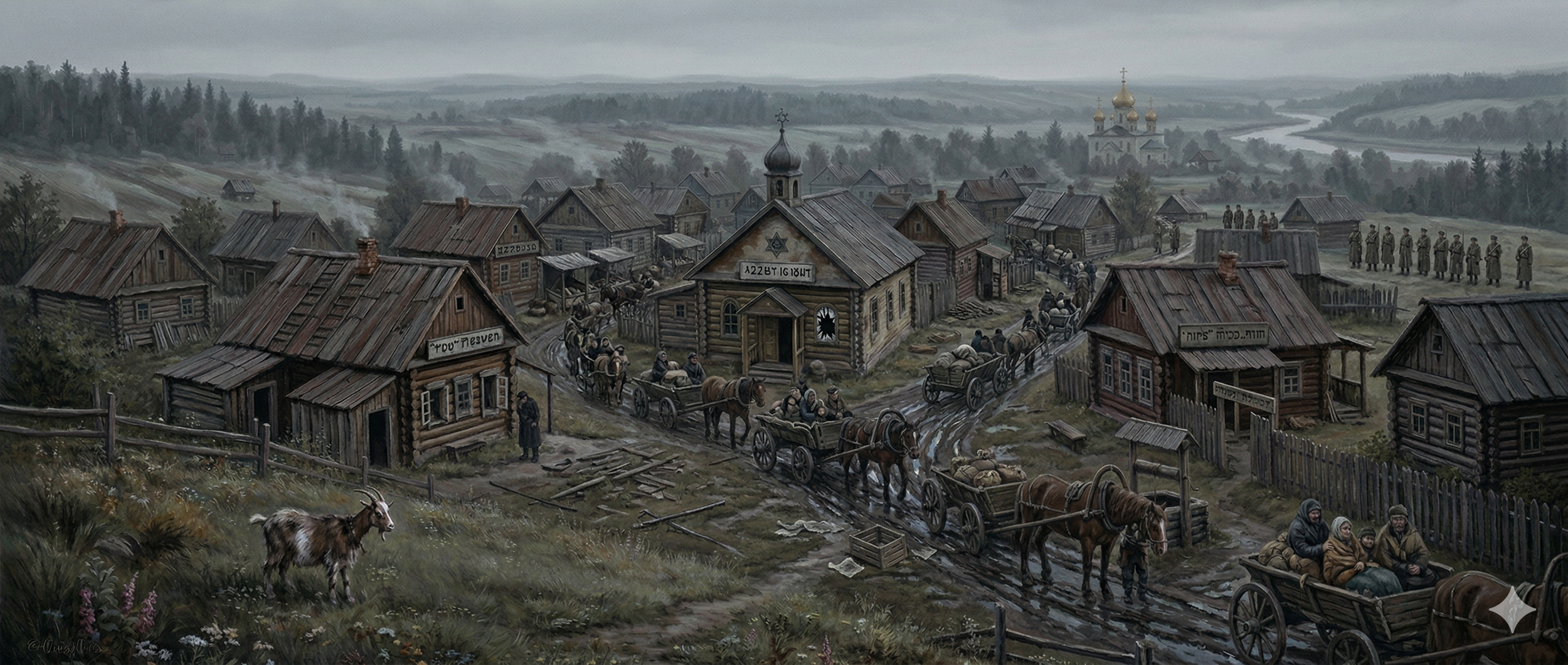
I am currently performing in a production of Fiddler on the Roof. I play three roles: an unnamed Anatevkan “Papa”, a Russian Orthodox Priest, and the “Russian Soloist” — who in this production functions as the Constable's enforcer.
It’s not in the published script, but in my private preparation I have come to the conclusion that my character (Alexei Grigoryev, because every character has a name) privately detests the Russian Constable. He is a man carrying immense guilt for his role against the people of Anatevka. At one point before the violent pogrom, he freely exclaims to the Jewish men in the tavern “Let us live together in peace”. He knows what he does and he does it anyway. That knowledge doesn't free him from the act nor the guilt that comes as a consequence.
Leo Frank was destroyed by exactly the kind of man I am playing in Fiddler. The machinery of persecution doesn't run on hatred alone. It runs on men like Alexei, who know better and participated anyway, who went home afterward carrying what he’d done and told himself he had no choice.
In my interpretation, Leo Frank, standing in that courtroom, knows those men are in the room but he is not addressing them.
He gave up on addressing them some time before this song begins. He is indicting them because the indictment needs to exist in the record.
He is talking to history, to his people, to everyone who will ever need to know that at least one man told the truth when the truth had no power to save him.
Now some thoughts and audition prep rituals I’d like to introduce. Most of these deserve their own post, and they will hopefully get one down the road. For know consider it a good summary on a few of my working process to get into the mind, heart, and body of a character.
Who am I talking to?
This is the first question I ask of any song. It’s not always the obvious choice.
In this case, I’ve made the perhaps abstract decision that Leo is not talking to the jury. He has already understood something the audience may still be catching up to. The verdict is written. The system has made its choice, and that nothing said in the room will change what happens to him.
The trial is theater and the outcome was determined before he took the stand.
Leo talks to history. To his people. To everyone who will ever stand where he stands and need to know that at least one man told the truth when the truth had no power to save him.
Leo’s fear takes center stage, but it does not diminish him. He embraces the vulnerability of the moment, leans into his fear, and speaks truth to power. The steady heartbeat of the sparse piano accompaniment accelerates and intensifies in coordination with Leo’s nervous resolve.
Finding the Beats
One of the first layers of my prep process is verb actioning, a rehearsal tool developed in the 1970s by British directors Bill Gaskill and Max Stafford-Clark. The principle is blunt: every genuine shift in intention gets one transitive verb.
Something your character does to another person. "I warn you." "I indict you." Not a feeling, not an attitude. A directed action that travels from you and lands somewhere.
Keeping it transitive is key. The formula is “I _____ you”. Not “I _____ to you” or “I _____ with you” - this is important for developing playable verbs.
One important element that took some trial and error to learn is that the discipline isn't in assigning verbs to every line. It's in finding the genuine shifts or the moments where the underlying intention actually changes, and trusting that one verb can hold a long passage if the intention holds. Over-assigning is its own trap. You end up tracking a grocery list when you should be living in the room.
For Leo’s testimony, I chose five verbs for the four main sections of the song.
“It’s hard to speak my heart
I’m not a man who bares his soul
I let the moment pass me by
I stay where I am in control
I hide behind my work
Safe and sure of what to say
I know I must seem hard
I know I must seem cold...
I never touched that girl
You think I’d hurt a child yet?
I’d hardly seen her face before
I swear, I swore, we’d barely met
These people try to scare you
With things I’ve never said
I know it makes no sense
I swear I don’t know why...
You see me as I am, you can’t believe I’d lie
You can’t believe I’d do these deeds
A little man who’s scared and blind
Too lost to find the words he needs
I never touched that child
God! I never raised my hand!
I stand before you now
Incredibly afraid
I pray you understand...”

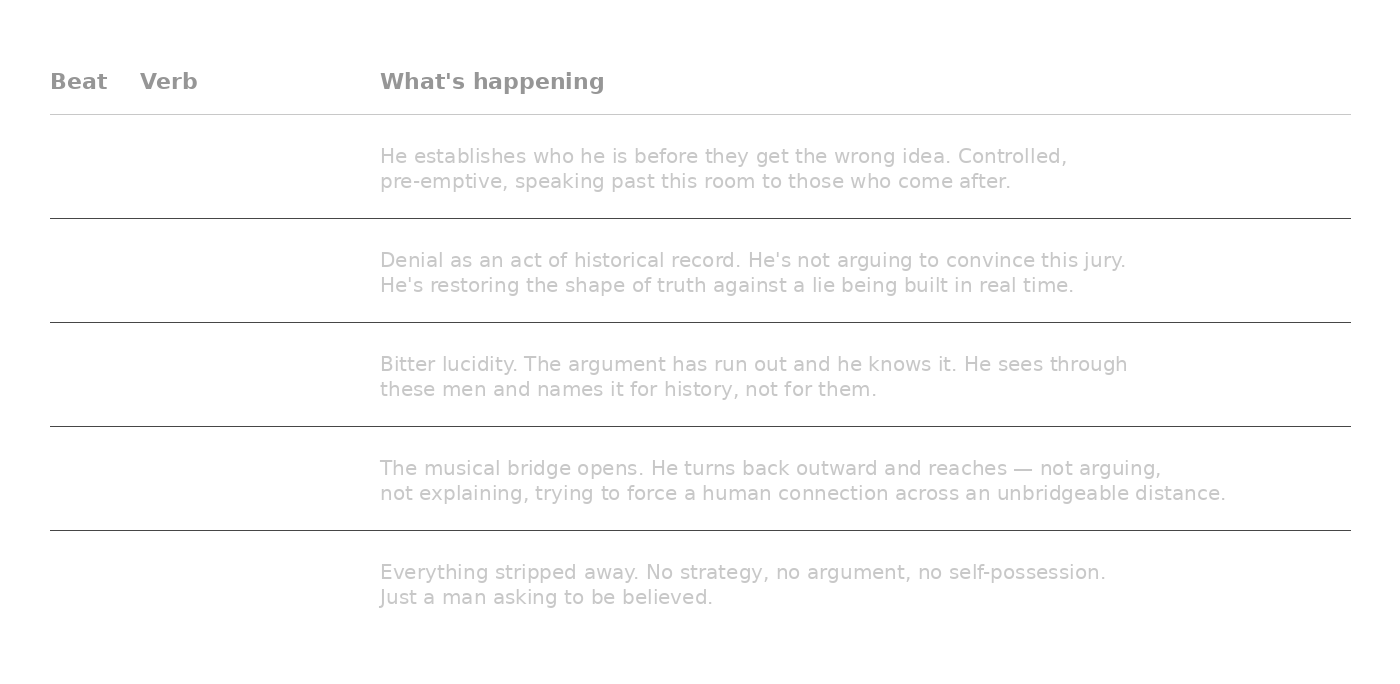
The move from warn to beg is the story of the song. The indict beat is what makes that journey feel true rather than sentimental. Without it, Leo is a sympathetic victim. With it, he is a witness.
The Body Doing the Work - Chekhov & Laban
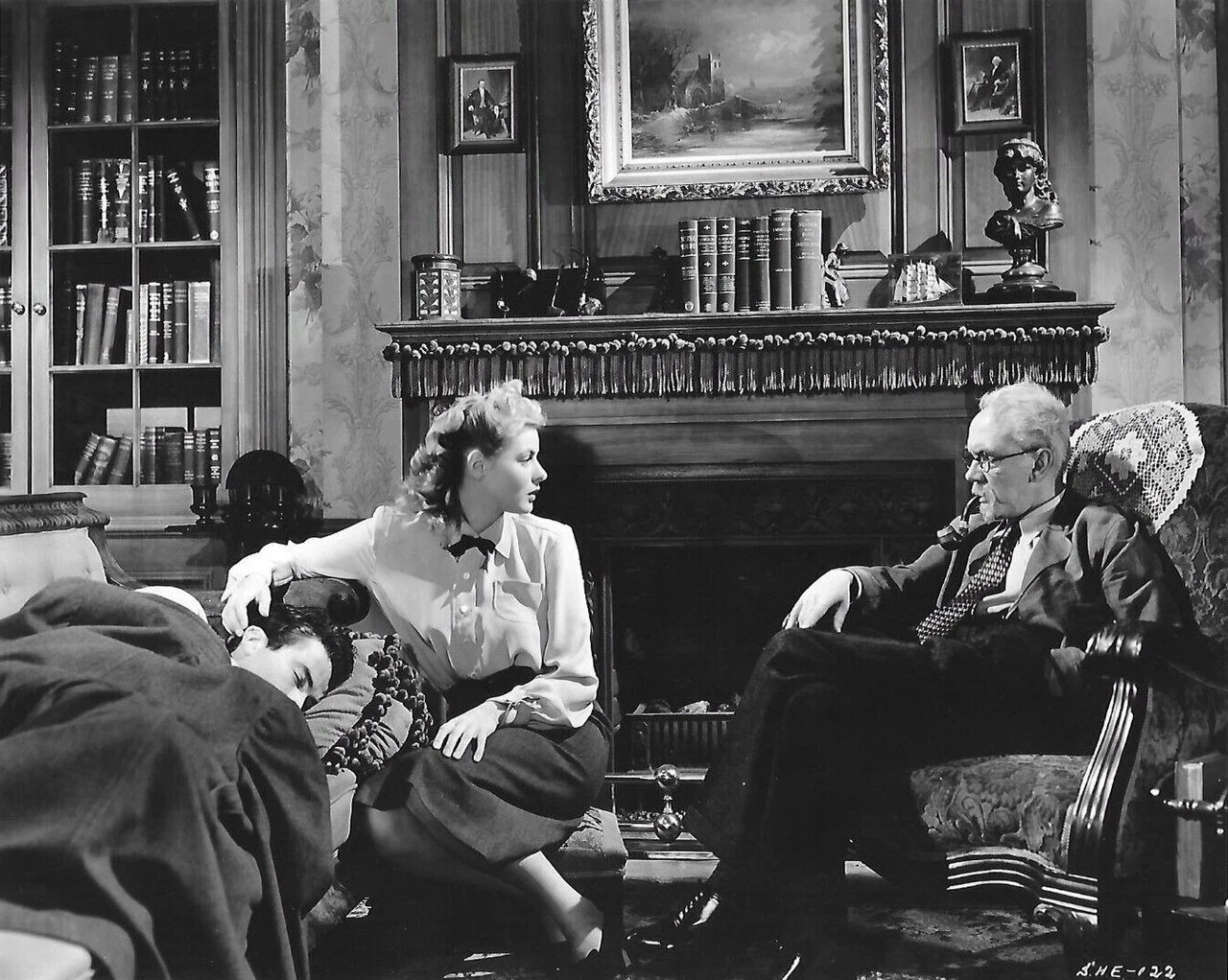
Michael Chekhov (right) with Gregory Peck and Ingrid Bergman in Hitchcock's Spellbound (1945). Chekhov (1891–1955), actor, director, and teacher. His psychophysical approach influenced generations of performers.
Knowing what I'm doing in a song is different from the body knowing how to do it. That's where Michael Chekhov's work comes in. As a young singer-actor I made the frustrating discovery that I had poor body awareness while performing. With the aid of numerous mentors, colleagues, and peers, I cam across the work of Michael Chekhov and it changed my performing life.
Chekhov — nephew of Anton, eventual departure from Stanislavski — built his technique around a deceptively simple premise: the body knows things the mind doesn't, and the path to psychological truth runs through physical commitment rather than emotional recall. His central tool, the Psychological Gesture, is a full-body movement that captures the essence of a character's state or intention. You practice it physically — fully, without restraint — until it becomes internally available without visible expression. The gesture trains the body, and the body carries the psychological charge into performance even when the gesture has disappeared from the outside.
Chekhov's archetypal gestures (push, pull, throw, tear, lift, crush) are defined entirely by their movement.
For this song, each beat gets a gesture:
B1 / Warn / Push — Arms extending forward with sustained, deliberate force. Placing something between my people and what's coming. Not aggressive. Purposeful.
B2 / Reform / Pull — Pulling a distorted reality back into its true shape. Hands moving against resistance.
B3 / Indict / Smash — A conclusive downward force. Not violent on the surface but final. Bringing the weight of truth down on what it lands on.
B4 / Compel / Reach and Draw — Arms extending outward then pulling back toward the chest. The reach is urgent. The draw back is slow.
B5 / Beg / Reach — Arms extending slowly outward and slightly upward, palms open. The opening is the result of the reach, not the gesture itself.
Every gesture has weight behind it. When working with beginning students on this process, the tendency is to half-ass the gesture. It needs weight and it needs effort. Once a student is able to assign verbs and psychological gesture with confidence and energy. The can take the physical away and allow the gesture to inhabit the same space only it is restrained to the mental domain. The same movement happens, yet only in the performer’s mind. Chekhov intends for the gesture to be discovered in rehearsal and then internalized during performance.
“Take a certain gesture, such as ‘to grasp.’ Do it physically... Now on the basis of this gesture, which you will do inwardly, say the sentence, ‘Please darling, tell me the truth,’ While speaking, produce the gesture inwardly... Now do them together - the gesture and the sentence. Then drop the physical gesture and speak, having the gesture inside only.”
Chekhov’s process was conceived for spoken dialogue but unlocks amazing power when added to the sung phrase. The ideal process for singers is similar to that which Chekhov delineates above.
Sing the phrase alone
Select an appropriate psychological gesture based on the text and your knowledge of your character. Try out each of the six standard gestures with the phrase and choose the gesture that feels most appropriate in your body.
Perform the psychological gesture alone, with energy and effort
Add the sung phrase to the performance of the gesture
Repeat until it is fully internalized. This may take many repetitions.
Remove the physical gesture and perform it internally, still accompanied by the sung phrase.
Rinse and repeat.
You will find a rare truthfulness begins to accompany your performance when imbued by the psychological gesture. This must be rehearsed because we rely on muscle memory to execute the internal action. We do not want to use mental capital when in performance so it needs to be repeated until the psychological actions are second-nature.
Once that has been achieved, we can add another layer of depth: Laban’s movement vocabulary:
Rudolf Laban (1879–1958) was a Hungarian-born movement theorist and choreographer whose primary contribution to performance training is the systematic analysis of human movement, codified in what became known as Laban Movement Analysis (LMA). His Effort qualities (Weight, Space, Time, and Flow) give performers a precise vocabulary for the quality of movement rather than just its shape or destination, distinguishing, for instance, between movement that is sudden versus sustained, direct versus indirect, strong versus light.
This effort vocabulary integrates remarkably well with Michael Chekhov's Psychological Gesture because the two systems approach the body from complementary directions: Chekhov works from an archetypal inner impulse outward, using a whole-body gesture to unlock psychological and emotional truth, while Laban gives the performer granular control over how that gesture moves through space and time.
For a singing actor, this integration is especially powerful. Chekhov's PG can anchor the interpretive intention of a phrase while Laban's effort qualities calibrate its physical expression to match the musical character, preventing either system from becoming abstract or disconnected from the score.
Laban Movement Analysis gives us a vocabulary for how a gesture moves, not just what it is. Rudolf Laban identified four Effort qualities that describe the physical character of any movement: Weight (strong or light), Space (direct or indirect), Time (sudden or sustained), and Flow (bound or free). Where Chekhov tells you what the body is doing and why, Laban tells you how it is doing it.
The two systems fit together naturally. A Lift gesture in the begging beat, for instance, carries light Weight, sustained Time, direct Space, and free Flow. The gesture is already doing its psychological work. Laban simply makes that work more specific. For a singing actor, that specificity matters because the voice will follow the body. When the gesture is precise, the phrase tends to be precise as well.
Reminder: we always start with effort in psychological gesture. If we progress to Laban work, we can rewire that effort.
Where the Eyes Go
There is a moment every performer knows. You are mid-phrase, the music is doing exactly what it should, and then something in the house catches your eye. A cough. A shifting body. A face you recognize. In that instant, you are no longer in Anatevka or a Georgia courtroom. You are on a stage, being watched, and your eyes have betrayed you.
Stanislavski identified this problem at the root of modern performance. The auditorium, he wrote, becomes a black hole that pulls the actor's attention away from the life of the scene. His solution was not to ignore the audience through willpower but to give the actor something more compelling to attend to. Concentration on an object creates a natural need to do something with it, and that doing pulls focus back into the world of the play. For singing actors this is doubly important because the music can become its own kind of black hole, a technical demand so consuming that the eyes go glassy and the face goes blank. The voice is working. Nobody is home.
Effective eye focus operates on three levels:
Immediate focus is intimate and personal, the object close at hand that grounds the character in a specific physical reality.
Mid focus opens outward to a more general field, appropriate for broader declarations or arguments directed at a group.
Distant focus is the most dangerous and the most misused. Singers reach for it constantly, especially in moments of high emotion, and what results is the classic thousand-yard stare: unfocused, unspecific, and unbelievable.
Distant focus only works when it is attached to something specific. You are not gazing into the void. You are looking at something, even if that something exists only in your imagination.
That last point is the key to unlocking what Stanislavski called the circle of attention. Before you can look at an imaginary object convincingly, you have to train yourself to look at real ones.
True observation, not staring, not performing interest, but actually seeing. What color is it. What is its weight. How does the light hit it. This quality of real attention, practiced on physical objects, transfers to imaginary ones.
For the singing actor, eye focus must be planned with the same rigor as breath management or vowel modification. It belongs in the score. Write it in.
The first maxim is simple: focus must accompany thought.
The second follows directly: thought must precede text. Something has to happen in the eyes before the mouth opens, because in life we think before we speak.
The third is the one most easily forgotten under pressure: anything mechanical is useless. A planned focus that you execute without real thought behind it is worse than no plan at all, because it creates the impression of someone going through motions.
The audience cannot always articulate what they are seeing, but they feel the difference immediately.
A focus also loses its power over time. Part of score study is identifying the moments where you pull your gaze away and return, or shift to an entirely different object, so that each new focus lands with fresh energy. This is called refueling.
In life we do not hold our gaze steadily on one thing while delivering a speech. We look away, we look back, we check for response. The score tells you when those moments are if you learn to listen to it that way.
The Audition Cut
The audition cut is not an excerpt. It is an argument. In the space of sixteen to thirty-two bars, you are making a case for your instrument, your technique, your interpretive intelligence, and your emotional range.
The first thing to understand is what the room is buying. An audition panel is solving a casting problem, and they need to know quickly whether you are the right fit. This means understanding the vocal demands of the role, the stylistic world of the piece, and choosing material that answers those questions efficiently rather than generally.
Enter the cut already in motion. One of the most common mistakes singers make is choosing a cut that begins with setup. If the first eight bars are harmonic and emotional throat-clearing before the real material arrives, cut them. The panel should feel, from your very first phrase, that they have walked into a scene already in progress. By the same token, end on your terms. The final moment is the last impression you leave and it should be a choice, not a default. A cut that ends on a quiet, specific, emotionally precise moment can be far more memorable than one that ends on a belt simply because the belt is available.
A strong cut moves through more than one emotional or dramatic state. If your sixteen bars are emotionally uniform, you are showing the panel one color.
The best cuts contain a shift, a moment where something changes and the character has to respond. This does not mean manufacturing drama that is not in the material. It means finding cuts where the material itself contains that movement.
The cut must also make sense as music. A cut that severs a harmonic resolution the listener's ear needs, or that ends before a cadence lands, will feel incomplete regardless of how well you sing it.
Finally, know the cut so thoroughly that the preparation disappears. An audition cut that feels studied has not been worked long enough. The goal is to arrive in the room with material so deeply internalized that your only job in the moment is to mean it.
For "It's Hard to Speak My Heart," the cut begins at the bridge, skipping the earlier material which functions as setup. Entering there drops the panel immediately into crisis. The arc moves from compulsion into begging, two distinct emotional states, so the panel sees range within a small frame. The cut ends quietly rather than on a climactic note, which is the harder and more specific choice. The final cadence lands cleanly, and the last impression is of a man who has given everything and still isn't sure anyone heard him.
What the Process Is Actually For
The actioning, the gestures, the Laban qualities, the eye focus architecture — none of it is the performance. It is preparation infrastructure. By the time you walk into an audition room, the framework should be invisible. What remains should just be a man with something urgent to say to someone who isn't there yet.
The tools in this post are not new. Stafford-Clark, Chekhov, and Laban each built their systems independently, across different decades and disciplines. What this post attempts is to put the pieces together in a way that is practical for the singing actor preparing a specific song for a specific room. The difference between a song that fits your voice and a song you've lived inside is not a matter of talent. It's a matter of methodology.
There is one thing no methodology can fully provide, and that is lived experience inside a related piece of material. When a performer is simultaneously working on two projects that speak to each other thematically, the work compounds. What one role puts in the body, the other can use. This is worth paying attention to when choosing audition material. The song that connects to something you are already carrying will almost always run deeper than the song that merely suits your voice.
Anthony Eversole holds a DMA in Opera and Voice Pedagogy from the University of Maryland and an MM from the University of Oklahoma. He is a stage director, voice pedagogue, and performing artist based in Salt Lake City, Utah.